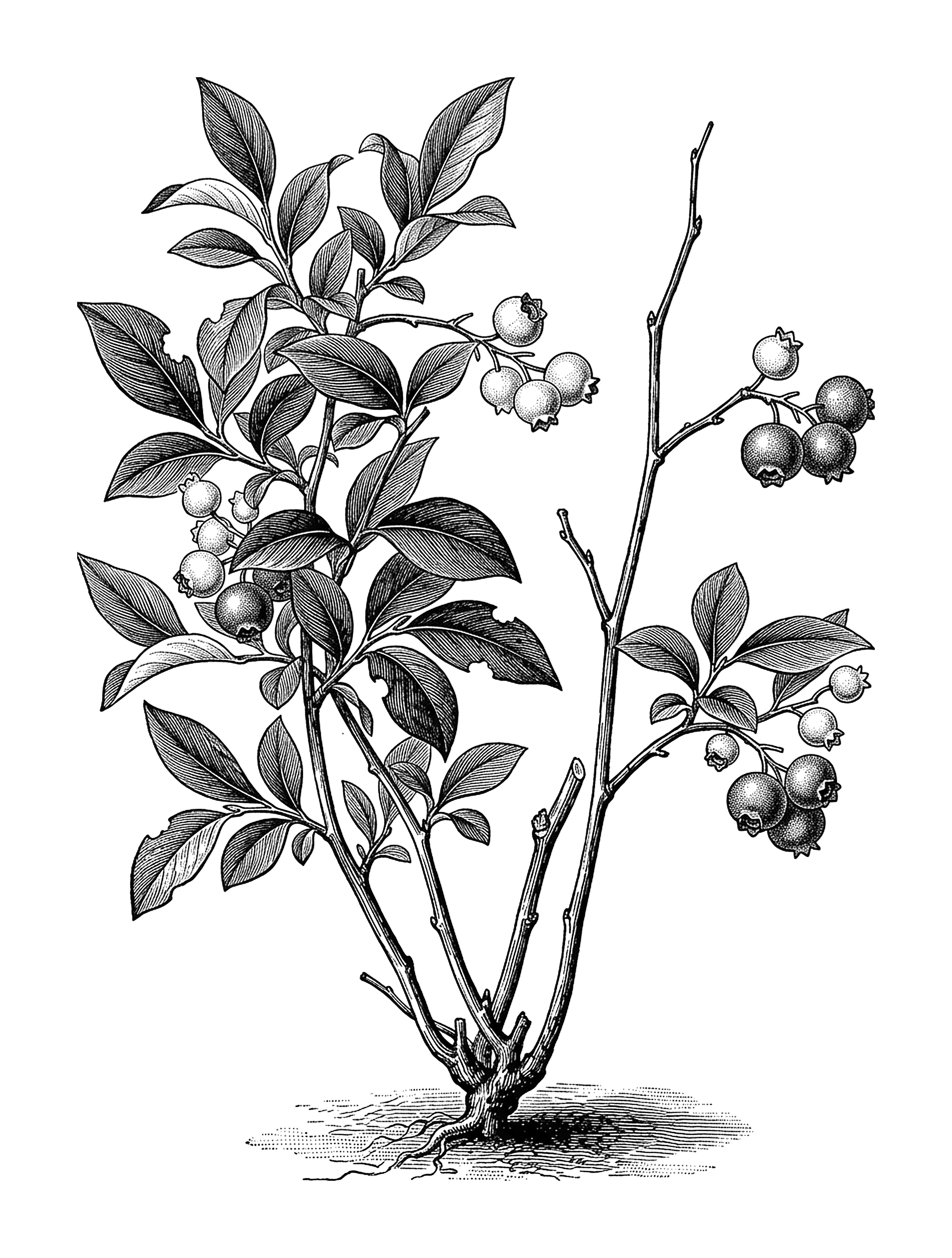
Blueberry
Vaccinium corymbosum
Ericaceae · heath family
Origin · North America
Also known as · Highbush Blueberry, Southern Highbush Blueberry
- Matures
- 5–8 months
- Harvest
- Over a period · Perennial
- Sun
- 6–8+ hrs
- Spacing
- 48–60 in
Planting window
When to sow, by microclimate — foggier blocks run a different calendar than sunnier ones.
| Jan | Feb | Mar | Apr | May | Jun | |
|---|---|---|---|---|---|---|
| Foggy | ● | ● | ● | |||
| Sunny | ● | ● | ● |
| Jul | Aug | Sep | Oct | Nov | Dec | |
|---|---|---|---|---|---|---|
| Foggy | ● | ● | ||||
| Sunny | ● | ● |
Sunlight
How well it does at each level of direct sun per day.
Soil depth
Root room it needs — useful for sizing raised beds and containers.
Soil pH
The soil acidity it grows best in — most crops sit just below neutral, so this mostly matters for heavily amended or long-reused beds.
- Preferred range
- pH 4.5–5.5
Spacing
Room each plant needs — along the row and between rows — for sizing beds.
- In-row
- 48–60 in
- Between rows
- 72–96 in
Growth habit
The shape it makes in the bed and how tall it gets — what tells you whether to give it a trellis, a stake, or just room.
- Habit
- Upright
- Mature height
- 4–6 ft
Stands on its own; the tallest types appreciate a stake in wind.
Growing in containers
Whether it does well in a pot, planter, or window box — the SF balcony-and-deck question, weighing its footprint, form, and staying power, not just root depth.
Happy in a pot, planter, or window box — no garden bed required.
How to start it
Sow it where it grows, or raise it under cover and set it out — and how far ahead to start the seedlings if it's the latter.
- Usually
- Direct-sow
Sown straight into the bed it will grow in.
Getting started
How it goes in the ground — how deep to sow or set it, and the soil temperature it needs to wake up. The cold-soil floor is the real limiter for direct-sowing in a foggy SF spring.
- Started from
- From crowns
- Ideal soil temp
- 60–70°F
- Set depth
- 0–0.5 in
Sprouts between 40–85°F; happiest around 60–70°F.
Watering & feeding
How thirsty and how hungry it is — the water it wants and how much feeding the bed needs to keep it producing. In the fog belt even a thirsty crop drinks less than it would inland.
- Water need
- Moderate
- Feeding
- Light feeder
Wants steady, even moisture — roughly an inch a week, a little more in a heat spell.
Undemanding — good soil is plenty; a rich, fed bed does more harm than good.
The make-or-break factor in SF is soil acidity, not water: southern highbush needs a soil pH of about 4.5-5.5, well below local ground, so it is not an ordinary in-ground crop here — grow it in a container (a half wine barrel is the classic choice) or a dedicated bed heavily amended with peat moss, and mulch with 3-4 inches of pine bark or pine needles to hold the acidity and keep the shallow roots cool and moist. Feed lightly: blueberries resent rich soil and are salt-sensitive, so use small amounts of an acid-forming fertilizer such as ammonium sulfate (21-0-0) and never nitrate forms, lime, or manure; if irrigation water runs alkaline, acidify it. The roots are shallow and fibrous and dry out fast, so water consistently — about weekly, more in a warm spell — but keep drainage sharp, because the plant will not tolerate standing water.
Pests & diseases
What tends to trouble this crop — what it is, what you'll see, and what to do about it, least-toxic first.
Birds are the number-one problem — they will strip a ripening bush, so drape 1/4-inch netting over a frame before the fruit colors and secure it at the ground. Spotted-wing drosophila is of greatest concern along the cool coast, where it stings soft ripening berries and lays eggs inside: pick often, chill the fruit fast, and clear fallen and over-ripe berries. The eastern blueberry maggot is not established in California, so it is not a concern here; in a damp, crowded planting, gray mold (Botrytis) and powdery mildew can appear on fruit and leaves, so give the bushes room and airflow and avoid wetting the foliage.
Pests2
Birds
- What you'll see
- Several bird species feed on ripening soft fruit, pecking or stripping berries as they color and often taking a large share of a crop just before it is ready to pick. Look for fruit that has been partly eaten, pecked, or knocked to the ground.
- What to do
- Exclude birds with 1/4- to 1/2-inch mesh plastic netting placed over the plant, ideally on a frame that holds the netting away from the foliage and is secured at the ground so birds can't reach fruit at the edges or slip underneath. Frightening devices such as noisemakers and visual repellents work only briefly, so rotate among them and don't rely on any one combination for more than a week.
Spotted-Wing Drosophila
- What it is
- Adults are small flies about 1/16 to 1/8 inch long with red eyes and a pale brown thorax and abdomen with black stripes; males have a black spot near the tip of each wing, and females a sawlike ovipositor. Larvae are tiny, white, cylindrical maggots a little longer than 1/8 inch when full grown.
- What you'll see
- Unlike most vinegar flies, the female cuts the skin of soft-skinned, ripening fruit with her sawlike ovipositor and lays eggs just under the surface, leaving a small puncture or 'sting'. The maggots then feed inside, causing the flesh to turn brown, soft, and sunken.
- What to do
- Remove and dispose of fallen and infested fruit in sealed bags, and harvest ripening fruit frequently and promptly. Fine mesh netting (about 1 mm) placed over plants before fruit begins to ripen keeps the flies out; monitor with vinegar or bait traps to time control.
Harvest & storage
How to tell it's ready to pick, and how to keep it once it's in.
- Keeps
- WeeksHolds a week or two in the fridge.
- Ready to harvest
- Don't rush the harvest: a berry that has just turned blue is still tart. Wait a few days until it is fully blue-black, plump, and parts from the cluster with a gentle roll of the thumb, and taste for sweetness before picking in earnest. Go over each bush every few days through the ripening window, picking in the cool of the morning.
- Storing
- Refrigerate the berries unwashed and dry in a covered or paper-towel-lined container, and wash only just before eating; kept cool and dry they hold about a week to two. Blueberries also freeze well — freeze them dry and unwashed on a tray, then bag them, for up to several months.
Culinary use & nutrition
What it's for in the kitchen, and the nutrients a 100 g raw serving is a notable source of.
In the kitchen
- Raw
- Baked & sweet
Nutrition highlights
- Good source
- Vitamin C, Vitamin K, Manganese
Share of the Daily Value in a 100 g raw serving (USDA FoodData Central).
Pollinators & wildlife
What this crop offers the garden's wildlife once it flowers — often the payoff for letting a bolting plant stand.
- Bees
- Honeybees and natives — bumble, mason, and sweat bees — working the flowers for pollen and nectar.
Blueberry's nodding, urn-shaped spring flowers are a bee crop: bumblebees are the standout pollinator because they buzz-pollinate, shaking pollen loose in a way honey bees can't, and the better the bee visits the larger and better-set the berries. Native bees and honey bees work the flowers too, and because blueberry blooms as part of cropping it feeds pollinators without having to be left to bolt. The ripe fruit, in turn, is a strong draw for songbirds — which is exactly why the crop needs netting (see pests).
Sources
Growing data on this page is drawn from USDA GRIN Taxonomy, UC Master Gardeners of San Mateo & San Francisco Counties, and the other references on our sources page.